Paper Wasps vs. Mud Daubers: Nesting Habits and Sting Risks Around Roof Eaves
Discover the key differences between paper wasps and mud daubers nesting under your roof eaves, including nest identification, sting risks, and effective removal methods.
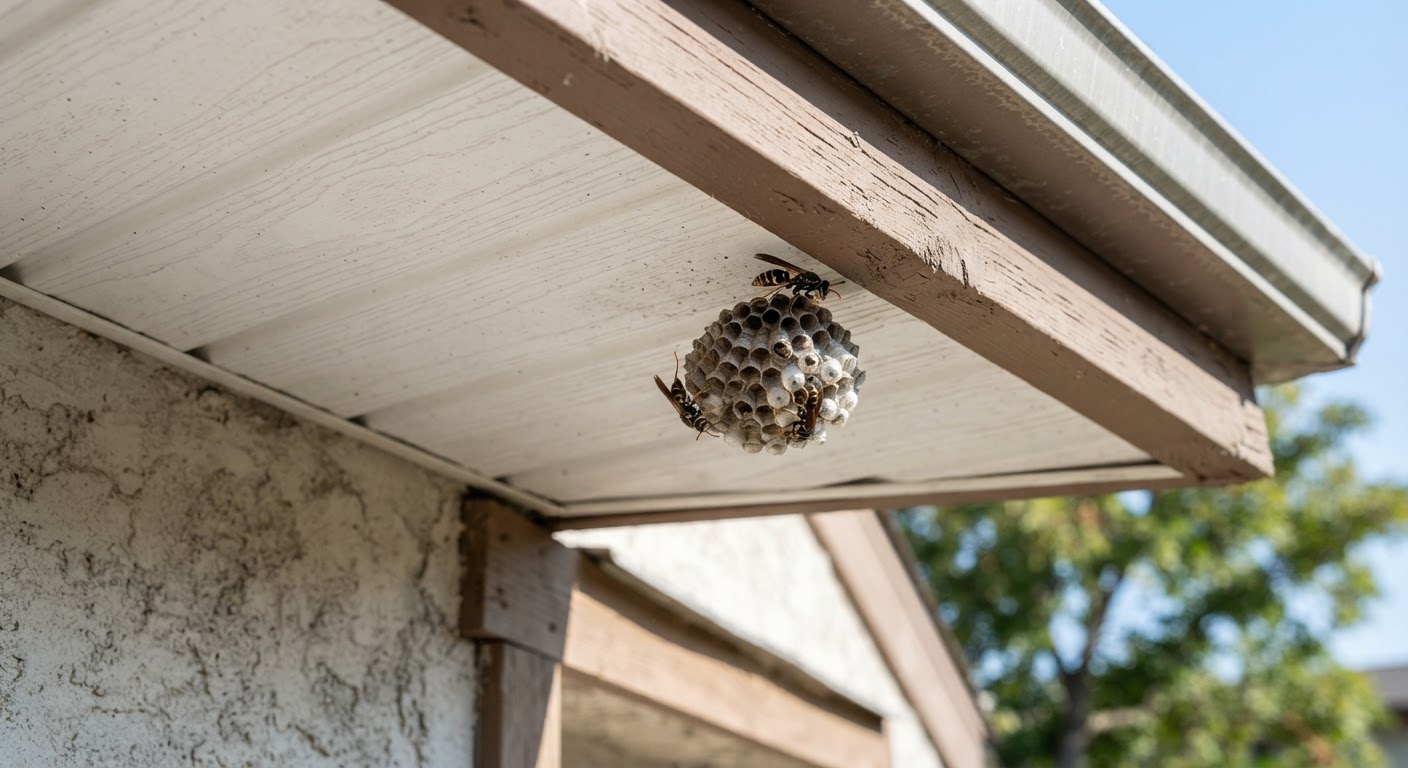
Distinguishing Common Flying Insects Under Roof Eaves
During the warmer months in San Antonio, property owners frequently look up to discover clusters of flying insects setting up residence along rooflines, patio covers, and soffits. Roof eaves offer an ideal architectural refuge: they shield nests from direct sun, guard against driving rain, and provide clear sightlines for foraging. Two of the most common culprits building under eaves are paper wasps and mud daubers.
While both insects belong to the order Hymenoptera and share a generally similar silhouette from afar, their behaviors, nest structures, and sting risks are drastically different. Distinguishing between a protective social colony of paper wasps and a solitary, docile mud dauber is the first step in deciding the appropriate course of action for your home and family.
Physical Characteristics: How to Tell Them Apart
Before examining the nest itself, observing the insect's body shape and flight behavior provides immediate clues regarding its identity.
Paper Wasps (Polistes species)
- Coloration: Generally brown or black with distinct yellow, reddish-brown, or orange striping or patches.
- Body Shape: Slender with a clearly defined waist, but their abdomen tapers smoothly to a point.
- Flight Style: Paper wasps fly with their long rear legs dangling visibly below their bodies, giving them an almost clumsy, hovering appearance.
- Size: Adults typically range between 0.7 to 1 inch in length.
Mud Daubers (Sphecidae and Crabronidae families)
- Coloration: Often uniformly glossy black, metallic blue-black, or black with bright yellow markings on the legs and thorax.
- Body Shape: Readily recognizable by an exceptionally thin, elongated stalk connecting the thorax to the abdomen, commonly referred to as a "thread waist."
- Flight Style: Direct, focused flight without the dangling leg posture typical of paper wasps.
- Size: Usually between 0.5 and 1.25 inches in length.
Nest Construction: Umbrella Paper vs. Packed Mud
The most unmistakable difference between these two insects lies in the materials and architecture of their nests. If you see insect activity under your roof eaves, inspecting the nest construction safely from a distance will tell you precisely what you are dealing with.
Paper Wasp Nests
Paper wasps are social insects. Queens start nests in the spring by gathering weathered wood fibers from fences, decks, and dead tree branches, chewing them, and mixing them with saliva to produce a gray or tan pulp. The resulting structure looks like an inverted umbrella or a single, exposed hexagonal honeycomb. Key characteristics include:
- Open cells pointing downward, allowing larvae and attending workers to be seen from below.
- A central stalk (pedicel) anchoring the nest to the underside of the eave or fascia board.
- Colonies that grow throughout the summer, often housing anywhere from a dozen to several dozen adult wasps actively guarding the comb.
Mud Dauber Nests
Mud daubers are solitary builders. Unlike paper wasps, there is no shared social colony; a single female constructs the nest by carrying wet soil or mud back from puddles, irrigated lawns, or garden beds. Their nests take one of several distinctive forms depending on the exact species:
- Organ Pipe Mud Daubers: Build smooth, vertical or horizontal tubes resembling the pipes of a church organ, side by side.
- Black and Yellow Mud Daubers: Construct irregular, fist-sized mounds or clusters of mud cells that look like a rough clod of dried dirt thrown against the wall.
- Blue Mud Daubers: Often do not build their own nests from scratch; they typically take over abandoned nests built by other mud daubers, moistening them and resealing the cells.
Once a mud dauber female provisions a cell with paralyzed spiders for her offspring to consume, she lays an egg and seals the opening with mud. After the cells are closed, no adult insects reside on or actively defend the structure.
Sting Risks and Aggression Levels
Understanding the temperament of each insect is critical for assessing safety around entryways, windows, and outdoor entertaining spaces.
The Paper Wasp Threat
Paper wasps are social and possess a strong collective instinct to defend their brood. If a person, pet, or ladder comes too close to an active paper wasp nest, the workers will fly out defensively. Because their stingers are smooth and lack the heavy barbs found on honeybees, an individual paper wasp can sting repeatedly without losing its stinger.
Stings deliver venom that causes immediate, sharp pain, localized swelling, and redness. For individuals with insect venom allergies, multiple paper wasp stings can trigger systemic reactions requiring emergency medical care. When nests are positioned over front doors, garage entries, or outdoor patios, the risk of accidental disturbance is high.
The Mud Dauber Temperament
Mud daubers pose almost no risk to humans under normal circumstances. Because they are solitary insects, they lack a colony defense mechanism. A female mud dauber has no interest in defending her mud tubes once the eggs are laid and the chambers are sealed. Even while constructing the nest, she will typically fly away if approached.
While female mud daubers are capable of stinging, they rarely do so unless physically trapped, squeezed, or stepped on. Their venom is primarily adapted to paralyze spiders rather than deter large predators, resulting in comparatively mild discomfort if an accidental sting does occur.
Secondary Problems Caused by Mud Dauber Nests
Even though mud daubers are docile and beneficial predators of common spiders, their nests should not necessarily be ignored. Abandoned mud nests create secondary pest concerns around eaves:
- Shelter for Other Pests: Old, vacated mud tubes frequently serve as harborages for opportunistic pests, including carpet beetles, dermestid beetles, spiders, and even secondary wasps.
- Aesthetic Damage: Hardened mud adhered to stucco, painted fascia, or brick can be stubborn to remove and can leave permanent stains if left in place through repeated weathering cycles.
Safe Management and Prevention Strategies
Managing wasp and mud dauber activity around rooflines requires deliberate planning to avoid painful stings and prevent structural staining.
- Regular Inspections: Check roof eaves, porch ceilings, and window frames beginning in early spring when solitary queens and mud daubers begin nest construction. Spotting a nest early makes removal significantly simpler.
- Avoid Direct Physical Disturbance of Live Paper Nests: Knocking down an active paper wasp nest with a broom or water hose often disperses defensive wasps across the yard, increasing sting risks for everyone nearby.
- Careful Mud Nest Removal: Ensure mud dauber nests are inactive before attempting removal. Once inactive, gently scrape the mud free using a putty knife and wash the remaining residue with mild soapy water.
- Sealing Entry Voids: Inspect soffits and fascia boards for cracks or gaps where wasps might move from the outer eave into your home's attic or wall cavities.
Professional Help for Roof Eave Pests
Distinguishing between benign mud daubers and protective paper wasps ensures you take the right measures to keep your outdoor areas safe. If paper wasps have established nests near your walkways, or if accumulated mud tubes are becoming an eyesore along your roofline, Golden Field Pest Control provides targeted, safe pest control services across San Antonio, TX to protect your home and restore your peace of mind.
Need help from Golden Field Pest Control?
Contact our team to discuss your service needs in San Antonio and surrounding service areas.